The Muay Thai economy of Phuket
How Muay Thai turned a quiet road near Wat Chalong into the most fitness-dense street in Southeast Asia, and what that economy looks like when you follow the money through the gyms, the stadiums and the visa offices.
Phuket Community · 18 November 2026
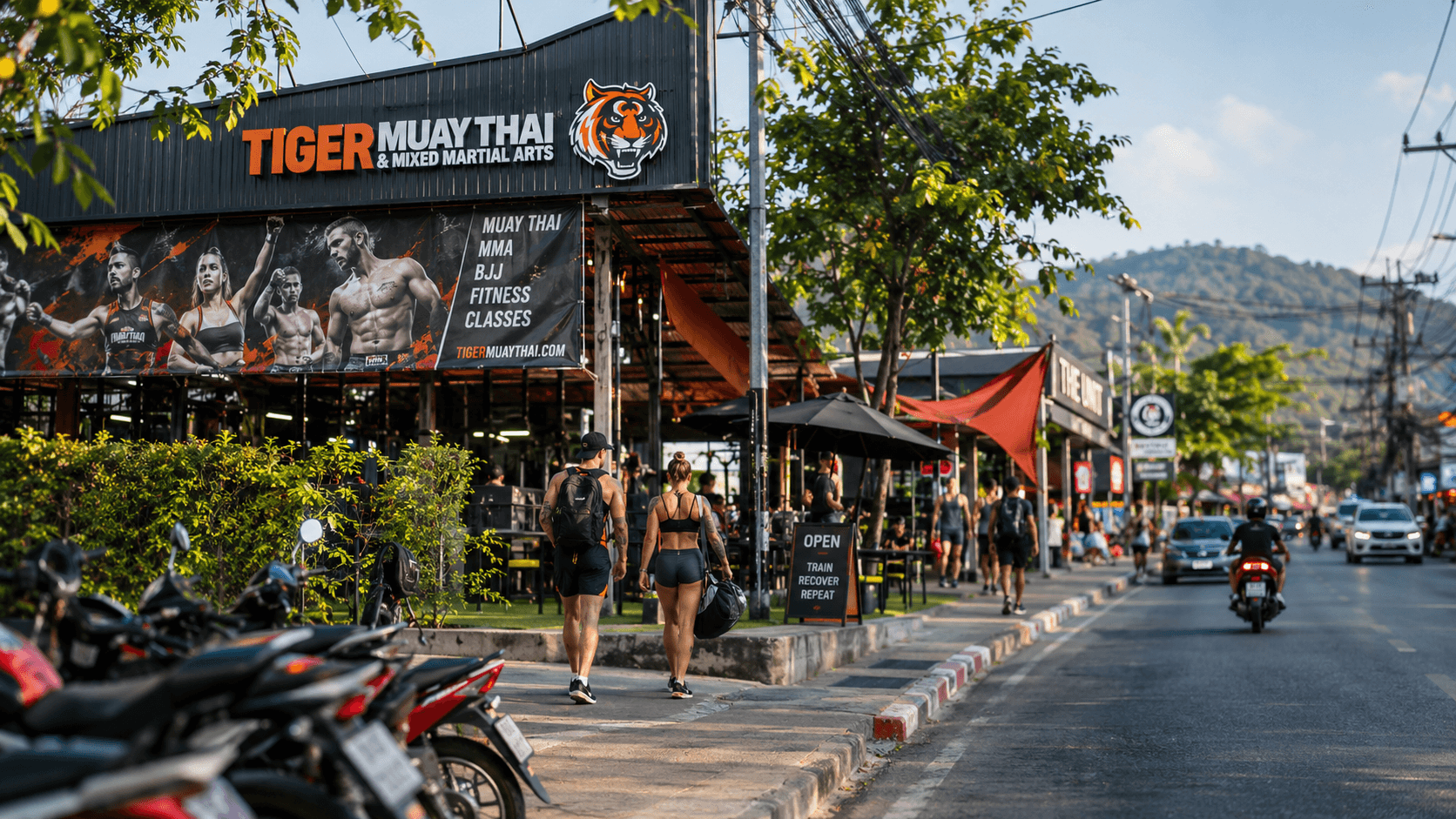
Soi Ta-iad is a 1.5-kilometre road near Wat Chalong that, fifteen years ago, was mostly coconut trees and a handful of local businesses. Today it holds more martial arts and fitness facilities per metre than any street we know of in Southeast Asia. Eight Muay Thai and MMA gyms. Four CrossFit boxes. Yoga studios, physio clinics, smoothie shops, accommodation blocks purpose-built for fighters on monthly stays. The street itself has become the product.
This is the story of how Muay Thai turned Phuket into a global training destination — and what that economy actually looks like when you follow the money through the gyms, the stadiums, the visa offices and the landlords renting rooms at ฿8,000 to ฿25,000 a month to people who came here to get punched in the face.
The gym that changed the equation
Tiger Muay Thai opened in 2003 on Soi Ta-iad. Founded by Sean Douglas, an American military veteran who saw what Phuket’s climate and cost base could offer the global fight-training market. The gym was early, aggressive, and good at the internet. By the time social media made training-holiday content a genre, Tiger had already built the brand.
The numbers matter. A single session at Tiger costs ฿500. A day pass runs ฿1,000. Weekly is ฿4,400 and monthly ฿13,500, plus 7% VAT on all of those. Douglas sold the operation in 2015 to Thai investors; the current managing director is Viwat Sakulrat. Tiger now operates three facilities: the Chalong headquarters, a beachside campus opened in 2019, and a Chiang Mai outpost from 2013. The brand has since expanded into Bali and Singapore.
The fighter pedigree is what keeps Tiger in the conversation among serious martial artists. Alexander Volkanovski, Valentina Shevchenko, Khamzat Chimaev, Petr Yan, Israel Adesanya — the list of UFC-level names who have trained here is genuinely long. That pedigree drives the casual market too. A substantial portion of Tiger’s monthly income comes not from professional fighters but from fitness tourists doing two-week packages.
Tiger proved the model. What came after it was an ecosystem.
The independents and the price range
The gym economy on Phuket now extends well beyond Soi Ta-iad, and the range is wide enough that generalising about cost is pointless without naming specifics.
Sinbi Muay Thai in Rawai, founded by Sinbi Taewoong (known locally as Khun Sing), charges ฿8,000 per month for one session a day and ฿12,000 for two. A three-month commitment brings it down to ฿27,000. Sinbi has its own stadium with Saturday night fight cards, which changes the atmosphere considerably. Accommodation in a shared twin room runs ฿22,000 to ฿26,500 for four weeks depending on season.
Bangtao Muay Thai and MMA in Cherng Talay opened in 2022, founded by George and Frank Hickman — both former Tiger coaches. Single session ฿500, day pass ฿800, weekly ฿4,500, monthly ฿15,000. Volkanovski trained here during his Phuket camps, which says something about the coaching quality relative to the price.
AKA Thailand in Rawai was built by Mike Quick Swick, a former UFC welterweight. The setup is serious: a 6,000-square-foot Muay Thai centre, a separate MMA and BJJ facility, a fitness building, basketball court, ice baths. Named Thailand’s best Muay Thai school three years running, 2021 to 2023. Head trainer is Kru Yuth, who carries more than 400 professional bouts and eight titles. AKA’s pricing sits at the premium end, which matches the facilities.
Sumalee Boxing Gym in Thalang takes a different approach entirely. Founded in 2011 by Dr Lynne Miller, Sumalee built its reputation on a more holistic model — yoga alongside Muay Thai, nutritional programming, smaller class sizes. Two rings, a pool, sixteen on-site rooms. Trainers include Kengkla Sor Kamsing and Mongkol Thong Sumalee, both with deep Thai fighting backgrounds.
Phuket Muay Thai in Rawai is owned and operated by Kru Bryan Dobler, who founded Double Dose Muay Thai in California before establishing this gym on Rawai Beach in 2021. Dobler is a former Chairman of WBC Muay Thai USA and trained under Ajarn Chai Sirisute. The gym sits directly on the beachfront with ocean-view accommodation and a modern training space. The teaching style leans Western — detailed technical explanations that make it accessible for beginners while keeping experienced fighters engaged. Free introductory sessions run on Saturdays, which is a low-commitment way to test the water.
Then there are the Thai-owned camps where the price drops and the training gets rawer. Rattachai Muay Thai on Soi Ta-iad is owned by Khun Nai, a three-time Lumpinee Stadium champion. Suwit Muay Thai has been running for more than 25 years and claims the title of Phuket’s first dedicated Muay Thai camp. These operations charge a fraction of what Tiger or AKA charge. They draw fighters who came for the training, not the content.
The pricing range across the island is dramatic. Drop-in rates run ฿300 to ฿800 depending on the gym. Monthly packages span ฿3,500 at the low end to ฿28,000 at the top. The Thailand-wide median for a monthly Muay Thai package sits around ฿10,000. Phuket’s average is higher, pulled up by the international brands that dominate the search results.
Fight night
Five stadiums run regular fight cards across the island, and the quality and feel differ enough that they are not interchangeable.
Bangla Boxing Stadium in Patong holds cards on Tuesday, Wednesday, Friday and Sunday, starting around 9pm. VIP seating ฿1,900, standard ฿1,500. The atmosphere is loud, tourist-heavy, and unapologetic about it. Fights range from genuine competitive matchups to entertainment-leaning tourist-night cards.
Patong Boxing Stadium runs Monday through Thursday. Ringside ฿1,800, standard ฿1,500. Slightly calmer crowd than Bangla, though still firmly in the tourist-district orbit.
Sinbi Boxing Stadium is the newest of the five. Saturday nights only, VIP ฿2,500. Attached to Sinbi gym in Rawai, which gives it a more authentic camp-connected feel.
Rawai Boxing Stadium operates Tuesday and Friday evenings, starting earlier — 6pm to 8pm. VIP ฿2,200. Rawai’s resident population means the crowd skews more local than Patong’s stadiums.
There is also the Bangtao Brawl, which runs on an irregular schedule and draws from the Cherng Talay gym cluster.
We have not reviewed every stadium personally. Card quality fluctuates week to week, and the line between competitive matchups and tourist-friendly showcase fights is not always clear from the ticket price. If you go expecting Thailand’s elite boxing circuit, adjust. Phuket’s stadium scene is real, but it sits below the Lumpinee and Rajadamnern tier in Bangkok. For a first Muay Thai fight experience, it delivers. For serious fight fans, ask around at the gyms about which upcoming card has the strongest lineup.
The government money
The Thai government valued its Muay Thai industries at more than 100 billion baht (roughly US$3 billion) in 2024. That figure includes gyms, equipment, events, media and tourism spend. It is a number you see quoted in every government presentation about soft power, and while we cannot independently verify the methodology, the order of magnitude feels plausible given the scale of the training-tourism market alone.
The Muaythai Soft Power Project allocated 275.65 million baht with specific targets: 4,520 foreign fighters and 120 foreign trainers brought into Thailand through official channels. The government’s stated ambition includes 500 standardised camps domestically and 50 abroad.
Practically, this has translated into the 90-day training visa — a category that did not exist a few years ago and that now brings a steady stream of medium-term visitors to Phuket specifically. The training visa sits between the tourist visa and the ED visa in both duration and paperwork. Most of the larger gyms handle the documentation.
Whether the soft power money materially changes Phuket’s gym scene or simply puts a government stamp on what the market built independently is an open question. The gyms were here before the policy. The fighters were already coming.
What Soi Ta-iad tells you about how this works
Walk Soi Ta-iad on a weekday morning and the economic machinery is visible. The gyms fill from 7am. By 9am, the cafes and smoothie bars along the road are full of people in training gear eating ฿250 acai bowls and ฿180 protein shakes. The accommodation blocks turn over monthly. Some are purpose-built training residences, others converted houses. The 7-Elevens at either end of the street do disproportionate trade in electrolyte drinks and compression bandages.
The street supports businesses that would not exist without the gyms. Physiotherapy clinics, sports massage shops, laundry services running double loads of sweat-soaked gear, scooter rental outfits that cater specifically to the monthly-stay fighter demographic. A barber opened in 2024 that is busy every afternoon. A tattoo studio draws on the post-fight adrenaline market.
Soi Ta-iad is not pretty. It is functional, slightly dusty, and organised around the rhythm of training sessions. First session 7am to 9am. Recovery and food 9am to 3pm. Second session 4pm to 6pm. Evening wind-down. Repeat.
The broader Chalong area has absorbed the spillover. Nearby accommodation fills with people on one-month and three-month training stays. Restaurants along Chao Fa West Road see steady trade from the gym population. The local economy around Soi Ta-iad has, over two decades, restructured itself around a market that barely existed when Tiger first opened.
And it has spread. Rawai’s gym cluster (AKA, Sinbi, and several smaller Thai camps) generates a similar but smaller economy in the south. Cherng Talay’s Bangtao gym scene caters to a slightly different crowd: families who want proximity to beach clubs and villas alongside their training. Revolution Muay Thai and Phuket King Muay Thai in Kathu add further options in the centre of the island.
What this means if you live here
If you are a resident, the Muay Thai economy touches your life whether you train or not. It shapes which neighbourhoods develop. It determines which roads get busier. It brings a population of fit, focused, short-to-medium-stay visitors who are distinctly different from the beach-holiday crowd — they spend on food, accommodation and training, less on nightlife and shopping.
Soi Ta-iad’s transformation from a quiet road near a temple to a global fitness destination happened without a masterplan. Sean Douglas picked a cheap street with space. Other gyms followed. The support businesses arrived. The accommodation market adapted. The government noticed and built policy after the fact.
For residents who train, the depth of options on Phuket is difficult to match anywhere else in the world at these prices. A professional-level Muay Thai session for ฿500. A month of twice-daily training for ฿12,000 to ฿15,000. Coaching from trainers with hundreds of professional bouts between them. BJJ with Marcio Cesar Gracinha, a fourth-degree black belt, at Lions MMA on Soi Ta-iad. CrossFit at Unit 27 or Titan Fitness within walking distance. The density of options within a fifteen-minute scooter radius of Chalong Circle is absurd.
We are building toward a full Muay Thai and martial arts category — gym by gym, trainer by trainer, with the same specificity we bring to restaurants and cafes. That will come in Q1 2027. This piece is the economic frame. The detail will follow.
If your gym is not named here, or if we have a price wrong, or if you know a camp we should visit: phuketcommunity.com/submit.
Gym pricing verified from published sources and direct enquiries as of October 2026. Prices change seasonally. Check directly with the gym before committing to a package.