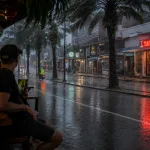
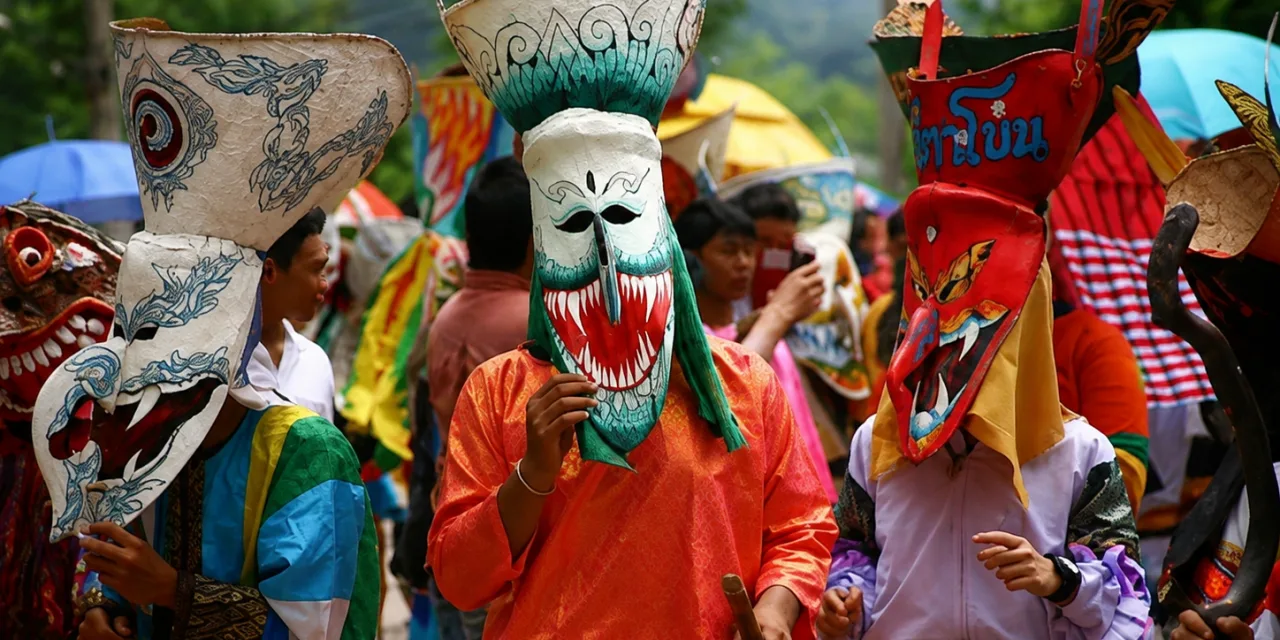
Every August, Old Phuket Town fills with incense smoke, towering red turtle cakes, and the sound of opera drums drifting through the streets after dark. That's Por Tor Festival Phuket, better known internationally as the Hungry Ghost Festival Phuket, and it's one of the island's most misunderstood cultural events. This guide clears up the confusion around the 2026 dates, breaks down exactly where to go (from the main shrine on Takua Thung Road to the street fairs on Ranong Road), and covers the food, symbolism, and etiquette you need to know before you visit, written by a local who's actually stood in the smoke.
Table of Contents
Walk down Ranong Road on the right evening in late August and you will smell it before you see it: sandalwood incense curling thick over the market stalls, catching the last orange light before dusk gives way to lantern glow. Stacks of red turtle cakes rise higher than your shoulder outside the shrine doors, and somewhere behind the smoke, opera drums are already warming up for the night.
This is Por Tor, Phuket’s version of what most of the world calls the Hungry Ghost Festival, and if you have ever tried to Google your way to a straight answer about it, you know how muddled the information gets. Wrong dates, wrong shrines, wrong idea of what actually happens. So let’s fix that, properly, with the 2026 dates that matter and the local knowledge to go with them.
And fair warning: this is only the first ghost story Phuket has for you this year.
What Exactly Is Por Tor (And Why Everyone Calls It the Hungry Ghost Festival)
Here is where the confusion usually starts. Por Tor, Hungry Ghost Festival, Ghost Month: people toss these around like they mean the exact same thing, and honestly, close enough, but not quite.
Por Tor is the Hokkien Chinese name for the festival, and it translates to something like “Universal Salvation Festival,” Po-to-choeh if you want to say it properly. That name comes straight from Phuket’s Hokkien Chinese community, who brought the tradition here generations ago. Internationally, most people just call it the Hungry Ghost Festival, which is really describing the purpose of the whole thing rather than naming it. And Ghost Month, or Gui Yue, is the bigger container that holds it all: the entire seventh lunar month, which in 2026 runs from August 13 to September 10.
So think of it this way.
Quick Explainer:
- Por Tor = the local Hokkien name for the festival itself
- Hungry Ghost Festival = the English nickname describing what it’s for
- Ghost Month = the full seventh lunar month the festival takes place within
Same story, three different labels. Now you know them all.
When Is Por Tor Festival 2026 in Phuket (Full Date Breakdown)
If you only remember one thing from this section, make it this: there are two calendars running here, and you only need to care about one of them for trip planning.
The full seventh lunar month stretches from August 13 to September 10 this year. That is the spiritual timeline, the underworld gates opening on day one and closing on day twenty nine, with families quietly tending private altars at home the whole way through. It is happening whether or not you show up in Phuket Town, and most of it you will never see.
What you actually want are the Por Tor Festival dates 2026 for the public side of things, the part with street fairs, shrine displays, and opera stages spilling out into the road. That window runs from August 19 to September 6, and if you can only make one day, make it Thursday, August 27. That is Zhongyuan, the cosmological peak, when the rituals and offerings hit their most concentrated point of the entire month.
Here’s the breakdown at a glance:
| Date | Lunar Day | What’s Happening |
| Thursday, August 13 | 1st day | Underworld gates open, private altars prepared |
| Wednesday, August 19 | 7th day | Public street fairs and shrine displays begin |
| Thursday, August 27 | 15th day | Peak day, Zhongyuan, biggest rituals and offerings |
| Sunday, September 6 | 25th day | Main street circuit at Seng Tek Bel Shrine wraps up |
| Thursday, September 10 | 29th day | Underworld gates close, month officially ends |
The Big Myth: Is Por Tor One Island-Wide Party? (No, and Here’s Why That Matters)
A lot of visitors picture Por Tor as one giant, three week party rolling across the whole island at once, every shrine lit up on the same night. It is not, and once you understand why, your whole trip gets easier to plan.
The spiritual side, the ancestor veneration, the feeding of wandering ghosts, that part genuinely does happen island-wide, quietly, all month. But the public celebrations, the street fairs, the opera stages, the processions, those are staggered across different shrines and neighborhoods. This is not an accident. Phuket’s Hokkien merchant guilds and shrine boards worked this system out over more than a century, and it exists for practical reasons: it stops shrines competing for the same resources, lets specialist opera troupes and Daoist priests rotate between venues instead of being everywhere at once, and keeps crowds from piling up in one spot.
Most neighborhood shrines only run their public ceremonies for a day or two. Seng Tek Bel is the exception, holding court for a full seven to eight days.
Which means you don’t need to cram everything into one weekend. You have options, spread across the entire month.
Where to Experience Por Tor in Phuket Town
Once you know the festival moves shrine to shrine rather than all at once, the next question is simple: where do you actually go? There is one clear main event, one major secondary hub worth building a night around, and a wider circuit of smaller shrines for anyone who wants to wander off the obvious path.
Seng Tek Bel Shrine (Por Tor Kong Shrine, Bang Neow), the Main Event
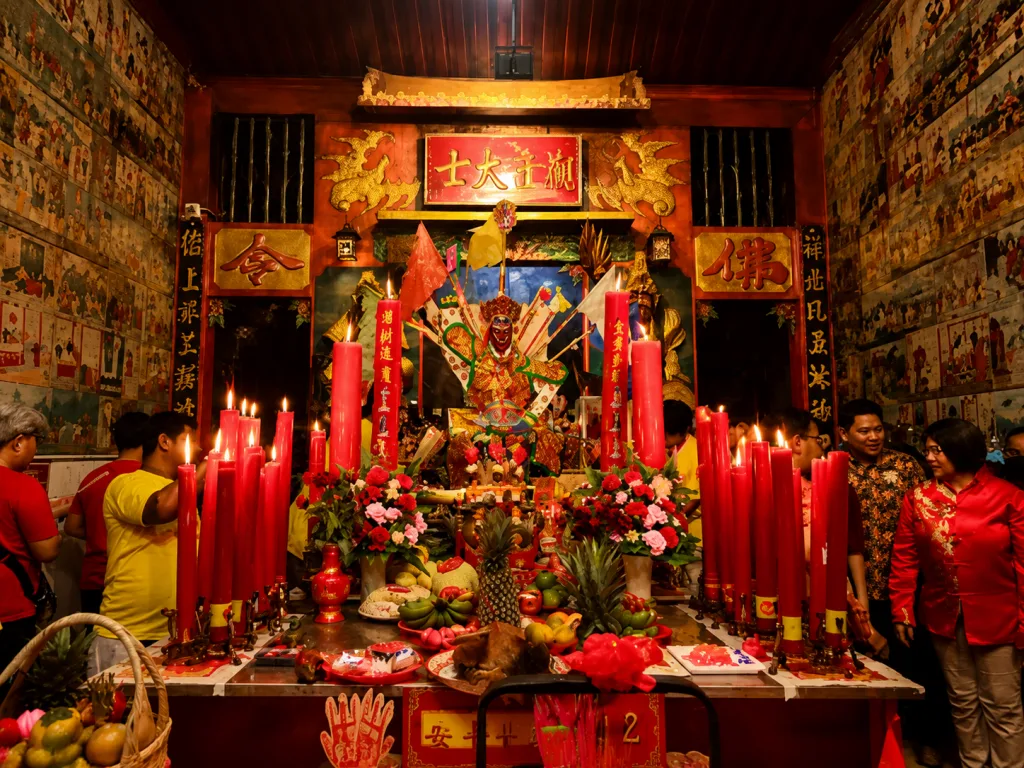
If you only visit one shrine this festival, make it this one. Locals call it San Chao Por Tor Kong Bang Neow, though its full name is San Chao Seng Tek Bel Kuan Im Tai Su, and it sits at 65 Takua Thung Road, tucked near Ban Bang Neow School just off Kra Road, close to the Surin Circle clock tower. It has stood there since around 1880, well over 140 years of continuous devotion, and the wall murals inside, restored in 2007, still tell their old stories of moral tales and underworld punishment in faded, careful color.
This is the shrine that runs the full seven to eight day sequence while everyone else gets a day or two. Step inside during Por Tor and you will find stepped wooden altars groaning under hundreds of ang ku and towering tua ku turtle cakes, sandalwood smoke thick enough to taste, Daoist chants layered under Hokkien opera drifting from an open-air stage, and a night market spilling down the street outside.
Honestly, it is also just a solid starting point if you are planning to explore the rest of Old Phuket Town on foot afterward.
Ranong Road Market, the Street Fair Everyone Talks About
Most people know this place as the fresh market, Talat Ban San or Talat Sod Ranong if you want the full name, but for a few weeks in late August it turns into something else entirely. Officially it is Municipal Public Market 1, and during Por Tor the second floor stops being a produce hall and becomes an elevated shrine, with banquet tables stretching out under whole roasted pigs, ducks, mountains of fruit, and giant red turtle cakes.
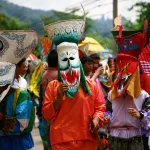
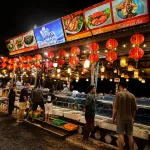
Down at street level, Ranong Road shuts to traffic completely and turns into a proper street fair, running from noon straight through to midnight. Lion dances, magic shows, live music, the occasional cabaret act, it is loud and bright and genuinely fun even if you do not understand every ritual happening around you. Civic parades march straight through the middle of it, flags and costumes and all, a real showcase of local culture rather than anything staged for tourists.
Beyond the Big Two, Smaller Shrines Worth a Detour
If crowds are not your thing, or you just like the idea of stumbling onto something the tour buses skip, the secondary shrine circuit is where Por Tor gets genuinely local. These smaller venues each get their own staggered slot on the calendar, so with a bit of timing you can catch several without ever fighting a crowd.
Secondary Shrine Circuit:
- Phuket Thaihua Museum, Krabi Road: catch this one early in Ghost Month for cultural exhibitions and youth performance showcases
- Hok Nguan Kong Shrine, Phuket Road near Surin Circle: mid-festival merit-making and blessing rites for local merchant families
- Jor Ong Shrine (Por Tor Talat Nuea), Krabi Road: staggered mid-month, with neighborhood altar displays for Talat Nuea residents
- Tong Yong Suu Shrine, Phuket Town: a multi-day mid-to-late window of Daoist scriptural chanting and mediumistic consultations
- Cherngtalay Fresh Market, Thalang District: staggered mid-month, serving northern Phuket’s Hokkien and Thai-Chinese farming community
What You’ll Actually See and Taste at Por Tor
Once you know where to go, it helps to know what you are actually looking at once you get there. Between the towering cakes, the fierce paper deity keeping watch over it all, and the food stalls doing brisk business well past dark, Por Tor has a look and a flavor all its own.
The Red Turtle Cakes Everyone’s Instagramming (Ang Ku and Tua Ku)
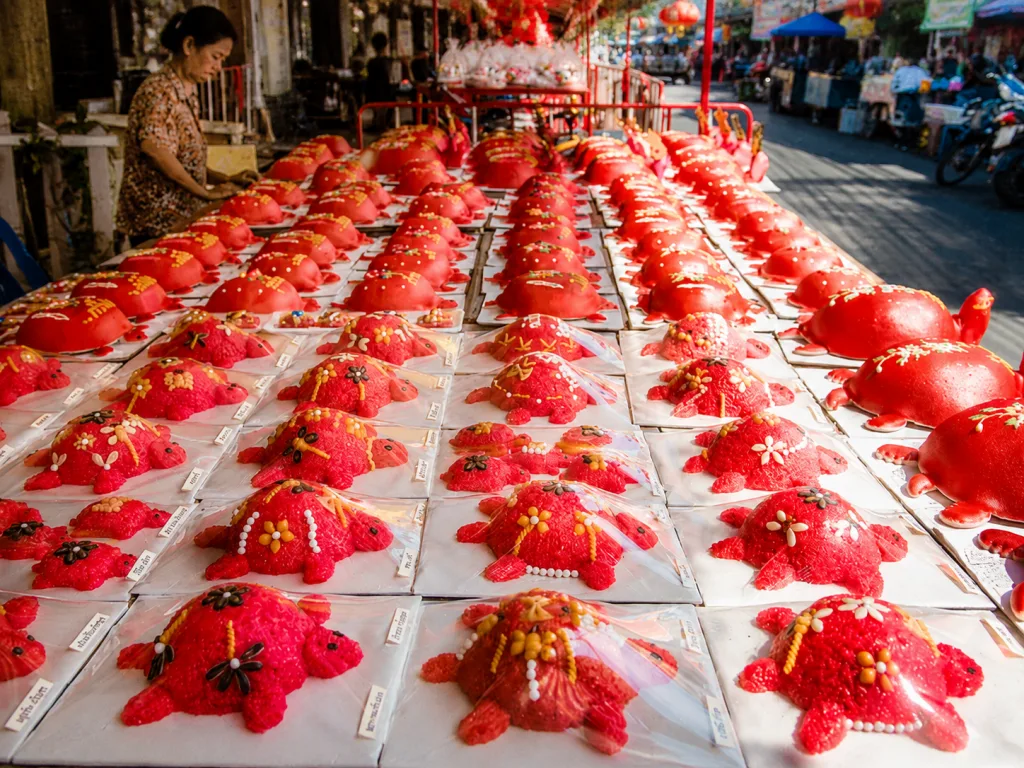
You will see these before you see almost anything else. Ang ku, the small sticky rice cakes filled with sweetened mung bean paste, dyed a deep crimson red and pressed into carved wooden molds so each one comes out stamped with a turtle shell pattern. The color and shape are not decoration for decoration’s sake. Red carries vitality, protection, and good fortune in Chinese iconography, while the turtle stands for longevity and stability, the kind that outlasts everything else. Offering one is a quiet trade: feed the deceased, and the living get long life and prosperity in return.
Then there is tua ku, and this is where Phuket does its own thing. These oversized turtle cakes, made from wheat flour, sugar, and red dye, can weigh anywhere from a few kilograms to well over a hundred. Wealthy merchant families, corporate sponsors, and neighborhood associations commission them, then stack them into towering pyramids at shrine altars, less a snack and more a public statement of devotion and standing in the community.
Da Shi Ye, the Ghost King Keeping Order
Look up at the major shrines and you cannot miss him. Da Shi Ye towers over the crowd as a massive paper effigy, blue or green faced, eyes rendered in flame, fierce enough to stop you mid-step the first time you see him. Perched right on top of his crown is a small figure of the Bodhisattva Guanyin, a quiet counterbalance to all that ferocity below.
His job is essentially crowd control, for ghosts. As the Ghost King and guardian deity of the festival, Da Shi Ye keeps order among the spirits gathered for the offerings, making sure the food and spiritual currency get shared out fairly, no chaos, no conflict.
The Food Stalls Worth Queuing For
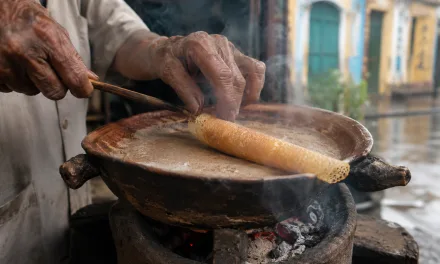
Come hungry, is the short version. Hoy tod is the first thing worth hunting down: crispy mussel or oyster omelet, fried on those big flat iron griddles until the edges crackle, served with bean sprouts and a sweet chili sauce that ties it all together. Right next to it you will usually find mee hokkien, stir-fried yellow egg noodles loaded with pork and seafood, dark soy sauce, and a soft-poached egg sitting on top waiting to be broken.
Loba is the one to try if you like your food with some funk to it: deep-fried braised pork offal, paired with fried tofu and spring rolls, dunked in a sweet-spicy sauce. For something lighter, ah-pong makes a good palate cleanser between stalls, thin coconut crepes cooked over small charcoal-fired woks until the edges go crisp.
And if you want to go deeper into the full spread of Hokkien cooking beyond the festival stalls, the zi char and dim sum tables here, steamed pork and shrimp dumplings, roasted duck, sweet mung bean dessert soups, are a solid place to start.
How to Visit Respectfully (This Isn’t a Tourist Show)
Worth saying plainly: Por Tor is not a performance put on for visitors. It is a sacred observance, deeply personal for the local families honoring their ancestors and feeding the wandering dead. You are welcome to watch, wander, and even join in a little, but that welcome comes with a bit of responsibility on your end. None of this is complicated, it just takes a little awareness.
Por Tor Etiquette Essentials:
- Dress modestly around shrine grounds and active altars, shoulders and knees covered, nothing too revealing
- Photography at public ceremonies is generally fine, but keep your distance from prayer queues, officiating priests, and spirit mediums
- Switch off your camera flash inside shrine buildings, and ask before taking a close-up portrait of someone
- Never step over food offerings laid out on street tables, ground mats, or shrine steps, and keep your hands off anything on the altars
- Give burning joss paper furnaces and incense stands a wide berth
- Buying an ang ku cake from a local vendor is a small, welcomed way to support the tradition rather than just photographing it
Local Taboos to Know Before You Go
A few extra house rules for Ghost Month, mostly things you would not think to avoid unless someone told you.
Do not stick your chopsticks upright in a bowl of rice. It looks harmless, but it mimics incense sticks in an altar bowl, which reads as an open invitation for spirits to come feed. Late-night swims in the sea are traditionally skipped too, since wandering water spirits, Shui Gui, are believed to be behind unexplained drownings this time of year. If you are the type to take these things seriously, maybe hold off on buying property, launching a business, or getting married until the seventh lunar month wraps up.
And if you find yourself wandering the alleys of Old Town after dark, keep the whistling and loud noise to a minimum. Sound, so the belief goes, is exactly what draws wandering ghosts your way.
Planning Your Visit: Timing, Getting There, and the Weather Factor
Right, the practical bit. Knowing the dates and the shrines only gets you halfway there, you still need to figure out when to show up, how to actually get into Old Town without losing an hour to traffic, and what to pack for a Phuket evening in green season.
Best Time of Day to Go
It really depends on what you are after. If you want good photos, get there between 15:30 and 17:30. The light is still natural and soft, parades are moving through the streets, vendors are setting up their altar displays, and bakers are still stacking those towering tua ku, all before the evening crowds roll in and make it hard to get a clean shot.
If atmosphere is what you are chasing, come back between 18:30 and 22:00. This is when Por Tor really shows off: incense smoke thickening over lantern-lit streets, opera and stage shows hitting their peak, everything glowing and loud in the best way. Just know the trade-off, crowds are heavier and the smoke inside shrine buildings gets noticeably denser once night properly falls.
Getting to Old Phuket Town Without Losing Your Mind
Let’s be honest about this part: driving in is not going to be fun. Takua Thung Road, Ranong Road, Kra Road, Yaowarat Road, all the streets around the main venues get heavy traffic once the festival kicks off, and parking near Seng Tek Bel Shrine or Ranong Market is basically nonexistent.
Your best bet is to park somewhere outside the historic core, near Saphan Hin Park or another peripheral spot, and just walk the ten to fifteen minutes into the shrine zone. It is not a bad walk, honestly, and it beats circling the block for half an hour. If you are on a scooter, you have an advantage, the narrow side alleys let you slip through and find temporary parking much closer to the action, which is worth keeping in mind if you are still figuring out how to get around Phuket in general.
Blue wooden songthaews run between the beach towns and Ranong Road Market during the day. Staying late, though, arrange a private taxi or ride-hailing service in advance for the trip home.
It’s Still Green Season, Pack Accordingly
One more thing before you head out the door: Por Tor falls right in the middle of Phuket’s southwest monsoon, what locals fondly call the green season. Late August and early September bring regular rain, usually short, heavy downpours that roll through in the late afternoon or evening, exactly the hours you will be out at the shrines.
Pack an umbrella or a light rain jacket, and skip the sandals with no grip. Shophouse walkways and shrine courtyards get slick fast once the rain starts, and non-slip footwear will save you more than one near miss. Worth checking what else this time of year in Phuket has in store for you, weather-wise, before you finalize the packing list.
Por Tor Is Just the Beginning
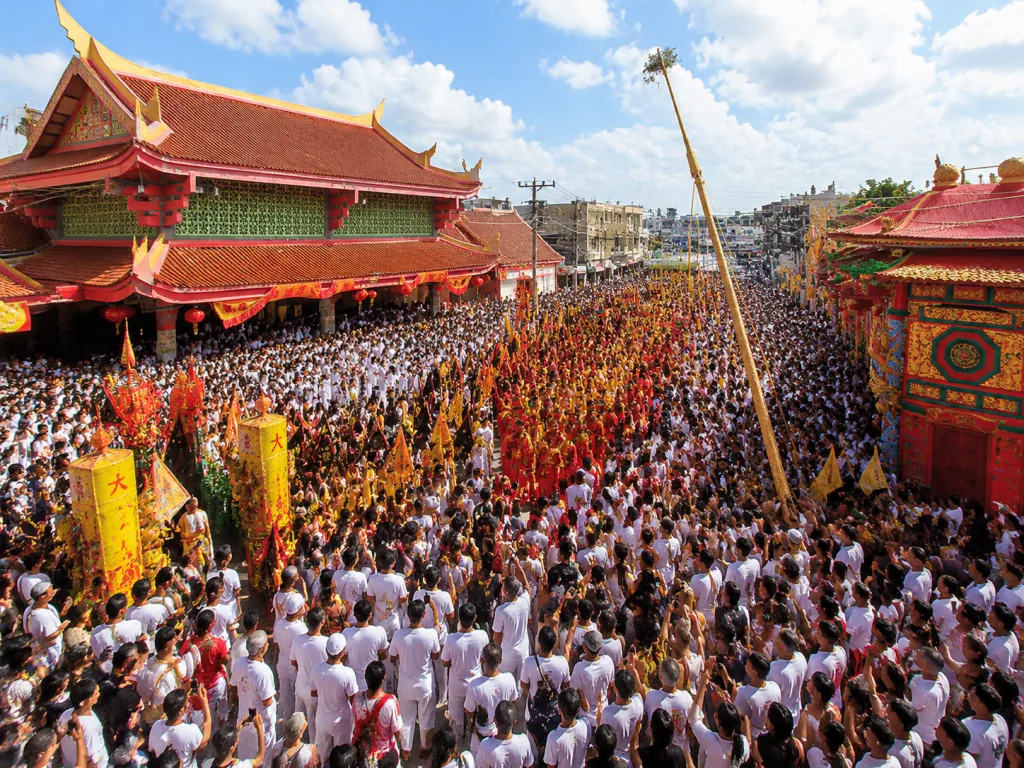
Remember that teaser from the start of this article? Here it is. Por Tor is not the only ghost-adjacent tradition Phuket has lined up this year, it is actually the opening act.
Where Por Tor is about filial piety, honoring ancestors, and offering peaceful gifts of food and paper currency to wandering spirits, the Phuket Vegetarian Festival takes things in a much more intense direction. Running October 10 to 18, 2026, during the ninth lunar month, it involves strict self-purification, full vegetarian diets, and street processions led by Ma Song spirit mediums, the ones famous for the piercings you have probably seen in photos.
Think of Por Tor as the island quietly setting the spiritual stage for what comes next. If any of this has caught your interest, it is well worth reading up on the Vegetarian Festival before October rolls around, because that one is a completely different level of intense.
Frequently Asked Questions About Por Tor Festival Phuket
What is the Por Tor Festival in Phuket?
Por Tor is Phuket’s Hokkien “Universal Salvation Festival,” observed across the seventh lunar month. At its core, it is about honoring ancestors and feeding wandering ghosts, blending Daoist and Buddhist tradition with local Thai merit-making customs.
When is Por Tor Festival 2026?
The full lunar month runs from August 13 to September 10. The public street festival window, the part most visitors plan around, falls between August 19 and September 6, with the peak day landing on Thursday, August 27.
Is Por Tor the same as the Hungry Ghost Festival?
Essentially, yes. Por Tor is simply the Hokkien Phuket name for the same broader tradition known internationally as the Hungry Ghost Festival, both observed during Ghost Month.
Where is the best place to see Por Tor in Phuket?
Seng Tek Bel Shrine on Takua Thung Road is the main hub, running an extended seven to eight day sequence. Ranong Road Market is the major secondary hub, with street fairs running noon until midnight.
Is Por Tor Festival safe and welcoming for tourists?
Yes, it is a public-facing event, though still a sacred one for local families. Visitors are welcome as long as they follow basic etiquette, dressing modestly and keeping a respectful distance from active rituals.
What should I not do during Ghost Month in Phuket?
Skip sticking chopsticks upright in rice, avoid late-night swimming, and hold off on major life decisions like weddings or new business ventures. It is also worth keeping the whistling and loud noise down in Old Town alleys after dark.
If you take one piece of advice from me, put the phone down for at least a few minutes while you’re there. Let the incense smoke settle around you, let the opera drums do their thing, watch the offerings pile up without rushing to caption it. Por Tor rewards patience more than it rewards a good photo.
I will be back with the full rundown before the Vegetarian Festival hits in October. See you there next.
If you want to keep exploring the island without the noise, we share one smart, local roundup each week in Phuket Community.
It’s focused on life in Phuket, written for residents, expats, and visitors who want the real island intel, not tourist clichés.
- Local knowledge that actually matters
- Delivered every week
- Because living well here starts with knowing what’s really going on
You can subscribe here: https://phuketcommunity.beehiiv.com or check out our app here: https://app.phuketcommunity.com