
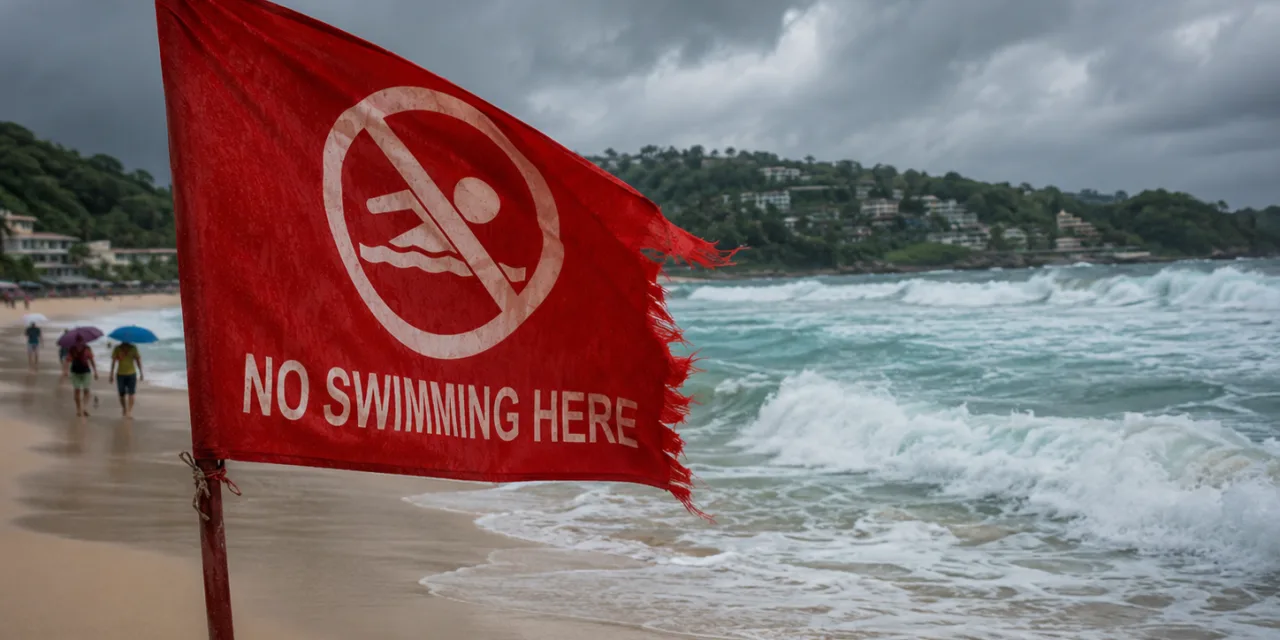
Heavy rain, flooded roads, and rough sea conditions have put Phuket in the spotlight this week. In this local update, we break down what visitors and residents need to know about Phuket Flooding June 2026, including affected areas, beach safety, travel impacts, and practical tips for navigating the island during an unusually wet start to the monsoon season.
Table of Contents
If you’ve been in Phuket lately, there’s a good chance your weather app has become part of your morning routine.
Check the sky. Check the radar. Check whether that little cloud icon is being dramatic again.
The rain has been heavy in parts of the island, some roads have flooded, traffic has slowed down in the usual low-lying spots, and red flags have been up on several west coast beaches. So yes, Phuket is definitely having a wet stretch.
But it is not a reason to panic.
Phuket is still moving. Flights are still arriving. Cafés are still pouring coffee. Restaurants are still open. People are still heading out, just with umbrellas in hand and slightly more flexible plans than usual.
That is the reality of Phuket Flooding June 2026. It is inconvenient in places, serious enough to pay attention to, but not the whole story of the island right now.
Below, we’ll break down what is causing the weather, where flooding is happening, what beach and sea conditions look like, and what visitors should know before making plans.
Why Is Phuket Flooding Right Now?
The short answer is that Phuket is firmly in its annual wet season, and this year the rain has arrived with a bit more enthusiasm than usual.
Every year, the Phuket monsoon season brings moisture across the Andaman Sea toward Thailand’s west coast. It’s a normal weather pattern, and it’s the reason Phuket’s landscape stays so green for much of the year. But sometimes those weather systems become stronger, carrying more rain than the island can comfortably absorb in a short period of time.
That’s what we’re seeing with Phuket weather June 2026.
A strong weather system sitting over the Andaman Sea has been pushing continuous bands of rain toward Phuket and the surrounding region. Instead of the quick afternoon shower many visitors expect, some areas have been seeing repeated downpours over several days. When that happens, drainage systems, canals, and low-lying roads can struggle to keep up.
The numbers tell the story too. Rainfall during May 2026 was significantly higher than normal, giving the island a much wetter start to the season than many residents are used to. By the time June arrived, the ground was already saturated in many places, meaning additional rain had fewer places to go.
If you’re visiting Phuket for the first time, it’s worth knowing that rain here doesn’t always behave the way people expect. One of the things locals quickly learn is that weather can vary dramatically across the island. It might be pouring in Kathu, while someone in Bang Tao is posting photos of blue skies and sunshine twenty minutes later.
That’s part of life during Phuket heavy rain events.
Most years, these weather systems come and go without causing major issues. But when several days of rain arrive back-to-back, temporary flooding becomes much more likely, especially in low-lying areas and along roads where water naturally collects.
A Strong Southwest Monsoon Has Arrived
If you’re new to Phuket, one thing worth knowing is that rain here doesn’t always build up slowly throughout the day. During the southwest monsoon, conditions can change surprisingly fast.
You might leave your hotel under blue skies, stop for a coffee, and twenty minutes later find yourself watching a tropical downpour hammer the street outside.
The reason is fairly simple. During this time of year, winds push large amounts of moisture across the Andaman Sea toward Phuket. When those moisture-filled clouds meet the island’s hills and higher terrain, the rain can develop quickly and sometimes quite intensely.
Phuket’s geography also plays a big role. The island isn’t flat. There are hills, valleys, and elevated areas spread throughout Phuket, which means weather conditions can vary dramatically from one neighbourhood to the next.
Locals see this all the time. It can be pouring in Kathu or around the foothills near Patong, while people in Bang Tao or Rawai are still sitting outside wondering what all the fuss is about.
That’s one of the reasons Phuket weather can seem unpredictable to first-time visitors. The rain is often highly localised, and the island’s landscape helps create those sudden shifts from sunshine to storm and back again.
Which Areas of Phuket Have Been Affected?
The recent flooding hasn’t been spread evenly across the island. As is often the case during periods of heavy rain, the biggest issues have appeared in low-lying areas where water naturally collects faster than drainage systems can clear it.
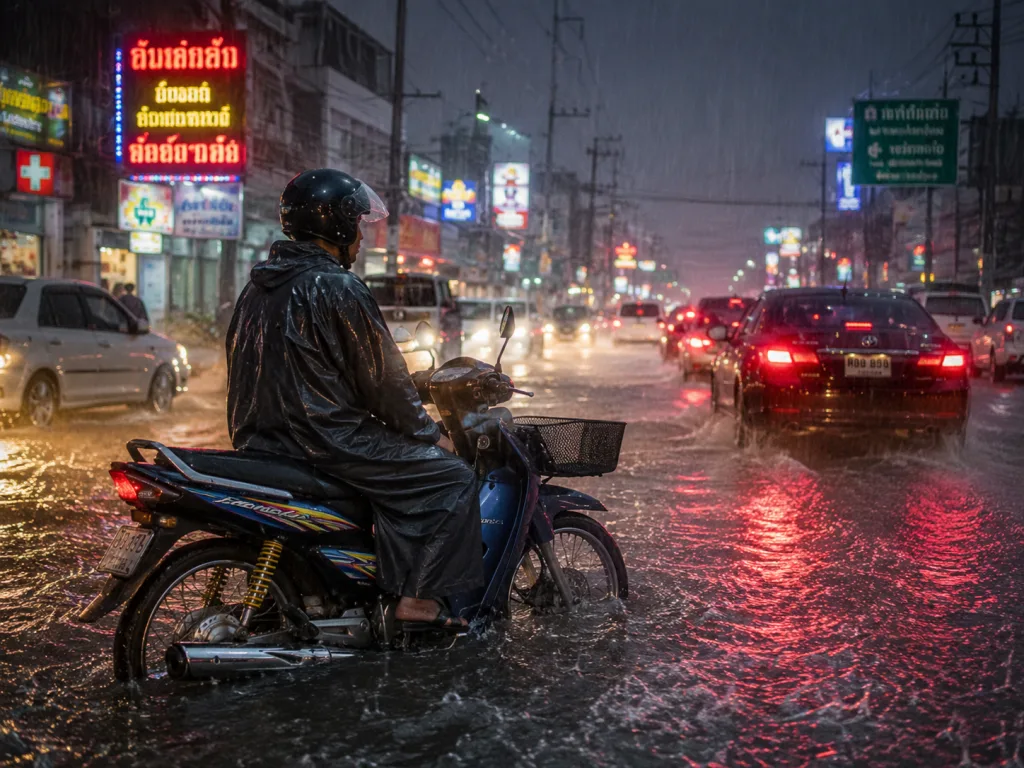
Some of the most visible flooding has been reported around Wichit, including sections of Chao Fa East Road. These are areas many locals drive through every day, so even temporary flooding can quickly create traffic headaches. A journey that normally takes fifteen minutes can suddenly take twice as long when vehicles are slowing down through standing water or waiting for flooded sections of road to clear.
That’s why you’ll often hear a Phuket flood warning focused on specific locations rather than the entire island. In many cases, the challenge isn’t the rain itself. It’s where that rain ends up once it starts running downhill.
Phuket’s landscape plays a big role here. Much of the island is made up of hills, valleys, and developed lowlands. When a strong downpour arrives, water naturally flows from higher ground into roads, canals, and lower-lying neighbourhoods. If enough rain falls in a short period, those areas can temporarily struggle to cope.
One thing that often surprises first-time visitors is how different the weather can be depending on where you are. It might be pouring rain around Wichit or Kathu, while people in Bang Tao are still having lunch outdoors without a drop falling from the sky.
Locals see this all the time. You can open social media and find one person posting photos of flooded streets while someone else, only a few kilometres away, is sharing a bright blue sunset. That’s part of living on an island with hills, changing sea winds, and a weather system that doesn’t always spread itself evenly across Phuket.
One of the funny things about living in Phuket is learning that “the weather” isn’t always one thing. You can be stuck in traffic during a downpour in Kathu, watching your wipers work overtime, while a friend in Rawai sends you a photo of blue skies and asks what you’re talking about. The island’s hills, coastline, and changing sea winds create little weather pockets of their own. After a while, most locals stop asking, “Is it raining in Phuket?” and start asking, “Which part of Phuket?”
Is Phuket Safe to Visit Right Now?
Yes, for most visitors, Phuket remains safe to visit right now.
If you’re looking for a quick Phuket travel update, the reality is that the island is dealing with a particularly wet period rather than a complete disruption to daily life. Flights are still arriving, hotels are operating as normal, restaurants are busy, and most attractions remain open.
That doesn’t mean the weather should be ignored. Heavy rain can lead to temporary flooding in some areas, traffic can slow considerably during downpours, and sea conditions are currently affecting beaches and boat trips. Visitors may need to adjust plans, especially those centred around the ocean.
For me, the most important distinction is the difference between inconvenience and genuine danger.
A flooded road that adds thirty minutes to your journey is frustrating. A boat trip being cancelled because of rough seas is disappointing. Those are inconveniences. Genuine danger comes from ignoring beach warning flags, driving through deep floodwater, or heading out on the water when authorities are advising against it.
If you’re asking, “Is Phuket safe to visit now?”, the balanced answer is yes, provided you stay aware of conditions and make sensible adjustments when the weather demands it. Most people currently visiting Phuket are still enjoying their holidays. They’re simply swapping rigid schedules for flexible ones and keeping one eye on the forecast before heading out for the day.
Are Flights Being Cancelled?
If you’ve got a flight coming up, the good news is that Phuket International Airport remains operational.
At the time of writing, flights are continuing to arrive and depart, and the airport itself has not been significantly affected by the recent weather. For most travellers, the bigger challenge isn’t getting on the plane. It’s getting to the airport on time.
That’s the key Phuket airport update right now.
Heavy rain can slow traffic considerably, especially when flooding appears on major roads or at busy intersections. Even short stretches of standing water can create bottlenecks as drivers reduce speed and traffic begins to back up.
If I were giving advice to a friend heading to the airport this week, it would be simple: leave earlier than you normally would.
Give yourself extra time for the journey, check traffic conditions before you leave, and keep an eye on the weather forecast if heavy rain is expected around your departure time. A trip that usually feels straightforward can take longer during a strong afternoon downpour.
It’s also worth remembering that weather conditions can change quickly in Phuket. Roads that are clear in the morning can become slow-moving later in the day after a burst of heavy rain.
A little extra planning now is much less stressful than watching the clock from the back seat of a taxi.
Phuket Beaches and Sea Conditions Right Now
If your Phuket plans involve beach days, swimming, island hopping, or simply spending time by the water, it’s worth paying attention to current Phuket sea conditions.
The southwest monsoon doesn’t just bring rain. It also affects the sea, creating larger waves, stronger currents, and rougher conditions along much of Phuket’s west coast.
Right now, red warning flags have been raised at many popular beaches, including Patong, Kata, Karon, Kamala, Surin, and Bang Tao. Whenever you see a red flag, it’s a sign that conditions are considered unsafe for swimming, regardless of how calm the water might appear from the shore.
One thing many first-time visitors don’t realise is that the biggest danger isn’t usually the waves themselves. It’s the rip currents.
A rip current is essentially a fast-moving channel of water flowing away from the beach. From the sand, it can sometimes look calmer than the surrounding water, which makes it easy to mistake for a safer place to swim. In reality, that moving water can carry people further from shore than they expect.
This is also why strong swimmers can still get into trouble. Swimming ability doesn’t always help when you’re dealing with moving water, changing currents, and waves that behave differently from those in a swimming pool or calm bay.
You may have seen people searching online for “Phuket beaches closed.” In most cases, the beaches themselves remain open, but swimming is strongly discouraged while red flags are in place. Visitors can still enjoy walks along the sand, watch the surf, visit beachside cafés, and take in the scenery.
The practical advice is simple. If you see a red flag, stay out of the water. Conditions can change quickly during monsoon season, and lifeguards are there for a reason. There will be plenty of opportunities to swim when the sea settles down again.
Why Swimming Is Dangerous This Week
The sea around Phuket can look beautiful even when it is not safe to swim in. That is one of the tricky things about monsoon weather. From the sand, the water might seem manageable. Once you are in it, the movement can feel very different.
Rough seas mean the waves are stronger, less predictable, and often arriving closer together. For families, this matters because children can be knocked over quickly in shallow water. For adults, it can be just as unsettling when the water keeps pulling at your legs while you are trying to stand.
Rip currents are another reason to take red flags seriously. A rip current is a narrow channel of water moving away from the beach. It does not always look dramatic. Sometimes it can even look like a calmer gap between waves, which is why people accidentally swim into them.
The simple way to think about it is this: waves push water toward the beach, and that water has to flow back out somewhere. During rough conditions, that flow can become strong enough to pull swimmers away from shore.
Shore break is the wave action right where the water meets the sand. On rough days, waves can break hard and suddenly in very shallow water. That can knock people off their feet, twist ankles, or send someone tumbling before they realise what happened.
This is why strong swimmers still need to be careful. Swimming in a pool or calm bay is very different from swimming against moving water, waves, and currents. Strength helps, but it does not cancel out the sea.
For first-time visitors, the best advice is simple. If red flags are up, stay out of the water. Let children play well back from the surf line, choose hotel pools instead, and save the ocean swim for a calmer day.
Are Island Tours and Boat Trips Running?
If you’re planning a day trip to Phi Phi, Coral Island, James Bond Island, or one of the many other popular destinations around Phuket, it’s worth paying close attention to current Phuket sea conditions before you head out.
The biggest challenge right now isn’t the rain. It’s the sea.
When strong winds move across the Andaman Sea, wave heights increase and conditions become much rougher for boats. Even experienced operators can face uncomfortable or unsafe conditions when waves become too large or thunderstorms move into the area.
This is why some tours, ferry services, and private boat charters may be delayed, rescheduled, or cancelled during periods of rough weather. While that can be frustrating if you’ve been looking forward to a trip, cancellations are usually made for safety reasons rather than convenience.
A Phuket storm warning often affects marine activities before it affects anything else on the island. Beaches may still be open, restaurants may still be busy, and roads may still be functioning normally, while operators out at sea are dealing with completely different conditions.
For visitors, the best approach is flexibility.
Check with your tour operator before leaving for the pier, keep an eye on weather updates, and understand that schedules can change at short notice. Most reputable operators would rather postpone a trip than put guests in uncomfortable or potentially risky conditions.
If a ferry or boat tour gets cancelled, try to see it as a sign that safety systems are working as they should. Phuket’s islands will still be there when conditions improve, and the experience is usually far more enjoyable when the sea is calm and visibility is better.
Sometimes the smartest travel decision isn’t pushing ahead with the plan. It’s waiting for a better day.
What Can You Still Do in Phuket When It Rains?
One of the biggest misconceptions about the rainy season is that Phuket somehow shuts down when the weather turns wet.
It really doesn’t.
Sure, a beach day might need to be postponed and a boat trip might get rescheduled, but that’s only one side of the island experience. In many ways, rainy days can be a great excuse to explore parts of Phuket that people often rush past when the sun is shining.
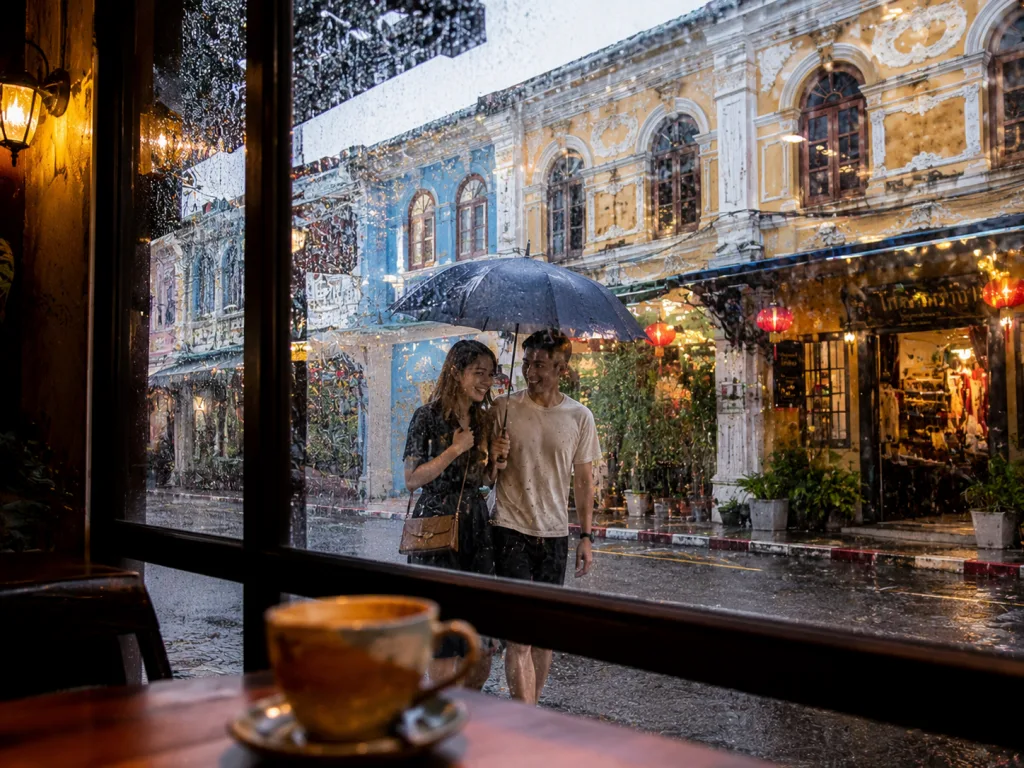
Phuket Old Town is a perfect example. The colourful streets, cafés, galleries, and local shops don’t lose their charm when it rains. If anything, there’s something quite nice about wandering through the historic streets between showers, ducking into a coffee shop, and slowing the pace down a little.
Some of my favourite Phuket days have happened when beach plans were cancelled. One afternoon that was supposed to be spent by the sea turned into several hours hopping between cafés in Old Town, followed by an unplanned lunch at a local noodle shop. It wasn’t the day I had planned, but it ended up being one of the days I remembered most.
Rainy weather is also a great opportunity to try a Thai cooking class. Not only do you stay dry, but you leave with a skill you can actually take home with you. The same goes for museums, cultural attractions, and local food experiences that often get overlooked in favour of the beach.
And then there are the spas.
Let’s be honest, there are few better places to spend a rainy afternoon than in an air-conditioned treatment room while the rain taps away outside.
If you’re looking for ideas, this is also a good time to explore our guides to Phuket Old Town, Rainy Day Activities in Phuket, and Local Food Experiences in Phuket. You may end up discovering parts of the island that weren’t originally on your itinerary.
The key thing to remember is that Phuket is much more than its beaches. The rain may change your plans, but it doesn’t have to ruin them. Sometimes it simply points you toward a different side of the island.
Is This Normal for June in Phuket?
Yes and no.
June is part of the Phuket rainy season, so rain itself is not unusual. This is the time of year when the southwest monsoon brings wetter weather to the island, especially along the west coast. If you visit Phuket in June, you should expect showers, cloudy spells, humid days, and the occasional proper downpour.
A typical June is not usually rain all day, every day. It often looks more like this: a bright morning, clouds building later, a heavy shower in the afternoon, then clearer skies again by evening. Some days are wetter than others, and some parts of the island get hit harder than others.
What makes Phuket weather June 2026 feel different is the amount of rain that arrived before June even properly got going. May was already much wetter than normal, which meant the ground, drains, and low-lying roads had less room to cope when more heavy rain arrived.
Think of it like pouring water into a sponge. A dry sponge can absorb quite a lot. A sponge that is already soaked starts dripping almost immediately. Phuket has felt a bit like that this year.
So yes, rainy weather is normal for June. But the intensity and timing of this current wet spell have made conditions more noticeable than a standard rainy season week.
Practical Advice for Visitors This Week
If I were giving advice to a friend visiting Phuket right now, it would be this: don’t try to fight the weather.
Work with it instead.
Most locals don’t cancel their entire day because rain is forecast. They simply adjust their plans. A beach walk becomes a café visit. An afternoon excursion moves to the morning. A long drive across the island gets postponed until conditions improve.
One of the easiest habits to adopt is planning outdoor activities earlier in the day. While rain can happen at any time, mornings are often calmer, making them a better window for sightseeing, markets, walks around Phuket Old Town, or other outdoor plans.
It is also worth checking forecasts regularly, but don’t become obsessed with them. Phuket weather changes quickly. A forecast showing rain all day doesn’t always mean twelve hours of continuous downpours. Many locals check radar apps before heading out rather than relying solely on the daily forecast.
A waterproof bag is another small thing that makes a big difference. Phones, passports, cameras, and electronics are much easier to manage when you’re prepared for a sudden shower.
When you’re driving or travelling around the island, avoid flooded roads whenever possible. Even shallow-looking water can hide potholes, debris, or uneven road surfaces. If a road looks questionable, it’s usually better to turn around and find another route.
Most importantly, keep your schedule flexible. Visitors often enjoy Phuket more when they stop trying to follow every plan exactly. Some of the best travel days happen when you leave room for adjustments.
The people who tend to have the best experience during a wet week in Phuket aren’t necessarily the luckiest. They’re the ones who adapt quickly, carry an umbrella, and treat the weather as part of the adventure rather than a problem to solve.
Final Thoughts
There is no point pretending otherwise. Phuket is going through a particularly wet period right now.
The rain has been heavier than many people expected, some roads have experienced flooding, beach conditions have become rough, and anyone hoping for a week of uninterrupted sunshine has probably had to adjust their plans.
At the same time, it’s important to keep the situation in perspective.
Phuket is still functioning. Flights are operating, businesses are open, and most visitors are continuing with their holidays. The biggest difference is that this is one of those weeks where flexibility matters more than having a perfectly planned itinerary.
If you’ve spent any time on the island, you’ll know that weather conditions can change surprisingly quickly. A grey morning can turn into a sunny afternoon. A heavy downpour can pass through in an hour. Sometimes the forecast looks worse than the reality, and sometimes the reality arrives faster than expected.
That’s life during the monsoon season.
The story of Phuket Flooding June 2026 isn’t really about an island coming to a standstill. It’s about an island adapting to a very wet stretch of weather, just as it does every year, albeit with a little more rain than usual.
For visitors, the best approach is simple. Stay informed, pay attention to local advice, give yourself a little extra time when travelling, and be prepared to swap plans around when necessary.
The weather may decide what kind of day you have. It doesn’t have to decide whether it’s a good one.
FAQ
Is Phuket flooded right now?
Some areas of Phuket have experienced flooding, especially low-lying roads and places where water collects quickly during heavy rain.
It is not the same across the whole island. One area may have flooded streets while another is mostly dry, so it is worth checking local updates before travelling across Phuket.
Is Phuket Airport open?
Yes, Phuket International Airport remains open and flights are continuing to operate.
The bigger issue for travellers is road travel to and from the airport. Heavy rain and flooded roads can cause delays, so allow extra time and check traffic before leaving.
Are Phuket beaches safe for swimming right now?
Many west coast beaches are currently affected by rough sea conditions, with red flags warning visitors not to swim.
If you see a red flag at beaches like Patong, Kata, Karon, Kamala, Surin, or Bang Tao, stay out of the water. Strong waves and rip currents can be dangerous even for confident swimmers.
Should I cancel my Phuket holiday?
Most travellers do not need to cancel their Phuket holiday, but it is sensible to stay flexible.
Flights, hotels, restaurants, and many attractions are still operating. Beach days, boat trips, and outdoor plans may be affected, so build in backup options and follow local advice.
When does Phuket’s rainy season end?
Phuket’s rainy season usually runs from May to October, with the southwest monsoon bringing wetter weather, stronger seas, and more frequent showers.
Conditions normally improve from November, when the dry season begins and the sea becomes calmer again.